Financial Analytics

An expansive suite of analytics tools for finance teams who appreciate the details.
No data was found

Integrations Include:

It seems we can't find what you're looking for.

veridian
us community
university
third federal
sunmark
sscu
space coast
peak
nusenda
numark
logix
leaders
gesa
dfcu
credit union 1
Communitywide
CapEd
cape and coast
4front
Suncoast CU
Quorum
P1FCU

Enjoy a practical and powerful data platform built for the needs of contemporary financial institutions

Single System Solution
GL Reporting
Financial Metrics
Transparent Data Dictionary

Profitability at the most granular level

Don’t assume profitability based on “averages of averages”. Connect to your data at the most granular level including interchange on transactions and interest spreads on individual products. 

Related

CUSTOMERS INSIGHTS

Powerful ML/Al-driven engagement,
segmentation, and predicitive actions

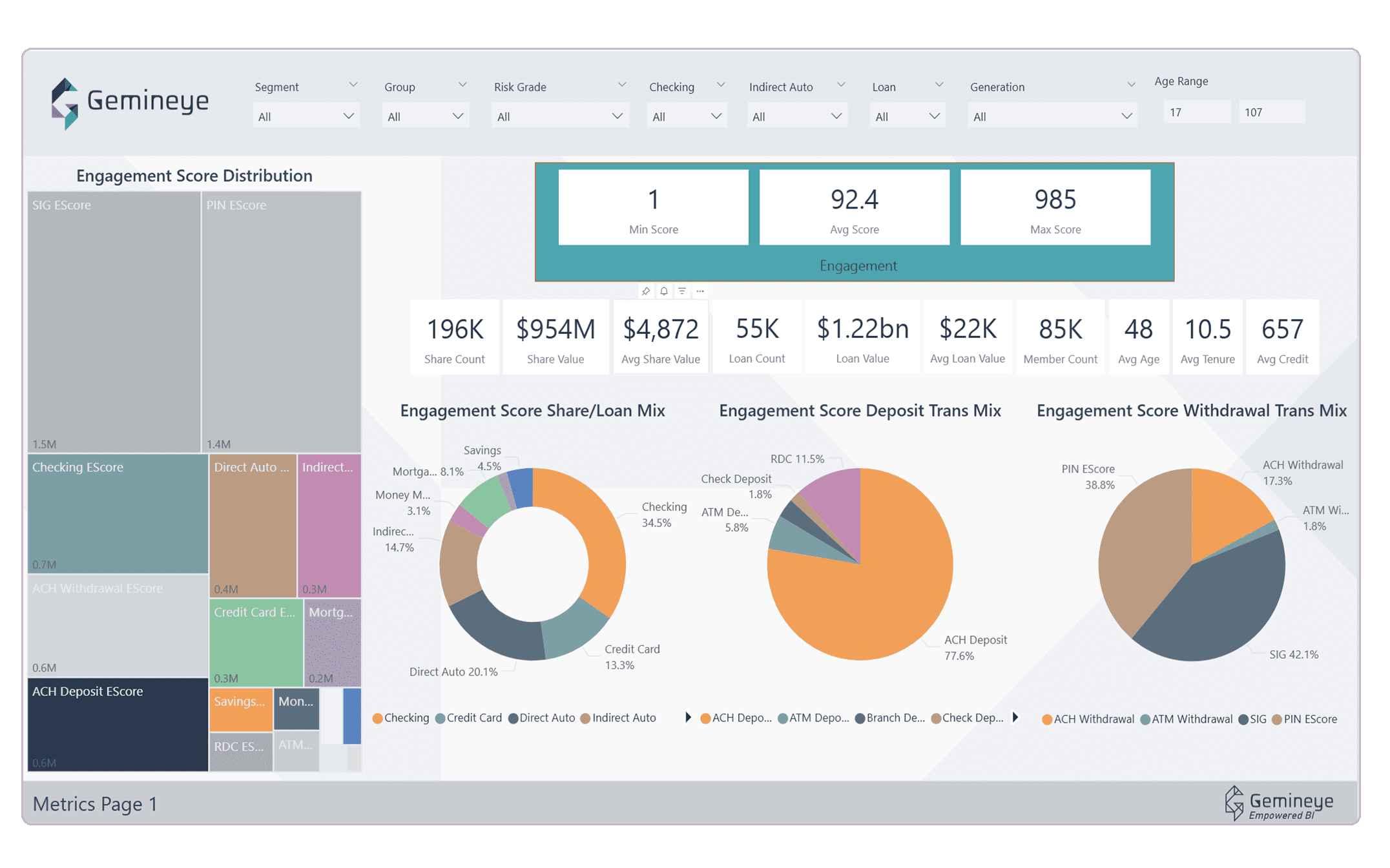
Gemineye data lakehouse metrics summary
Definition Customization
Gemineye data lakehouse metrics summary

Definition Customization

Definition Customization documents fully integrated into the solution and design to ensure your team knows exactly how all fields move from source to the data warehouse to the dashboards and reports.

Advanced Lakehouse Monitoring

Advanced Lakehouse Monitoring

Advanced Lakehouse Monitoring documents fully integrated into the solution and design to ensure your team knows exactly how all fields move from source to the data warehouse to the dashboards and reports.
Gemineye data lakehouse metrics summary

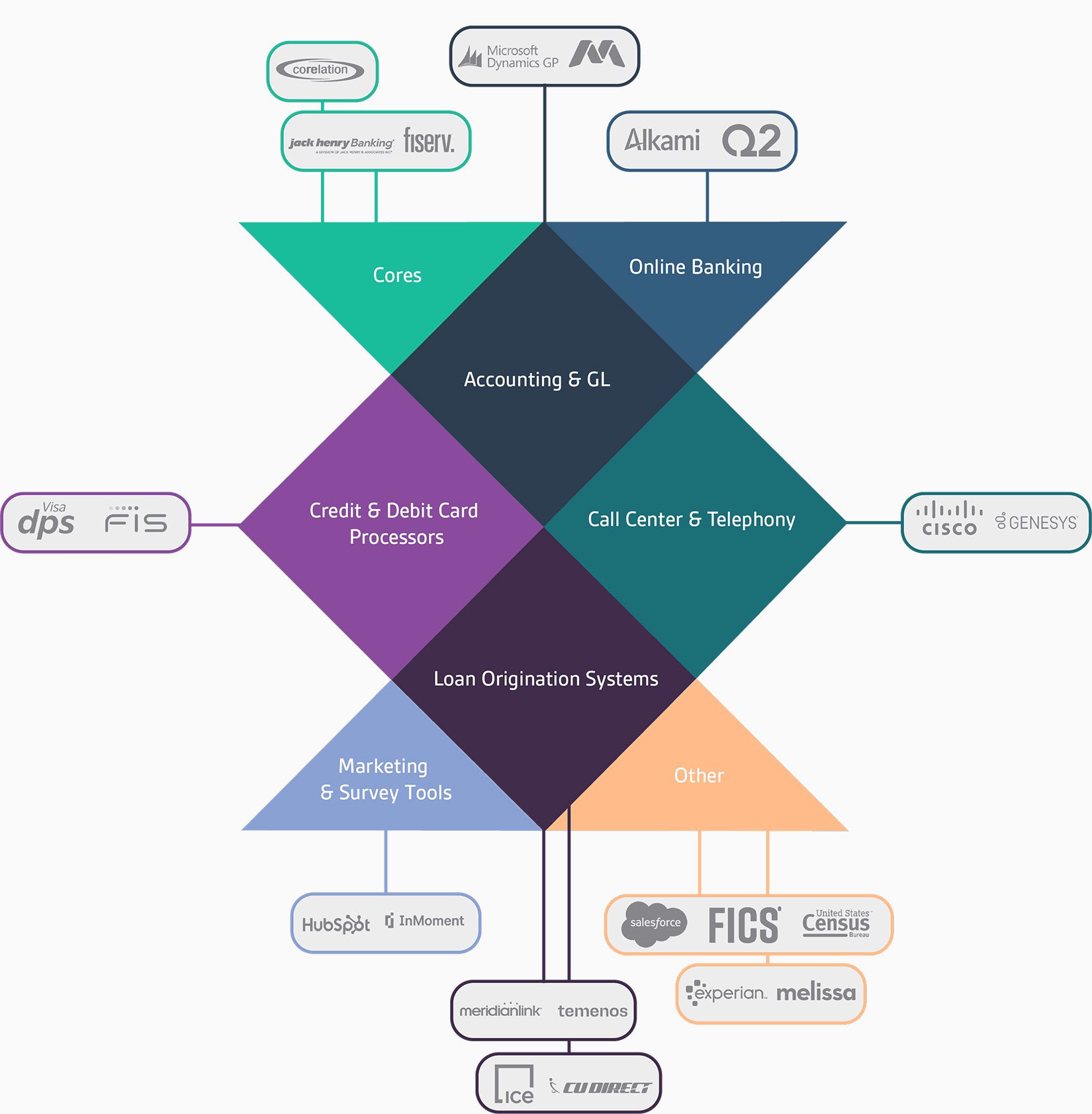
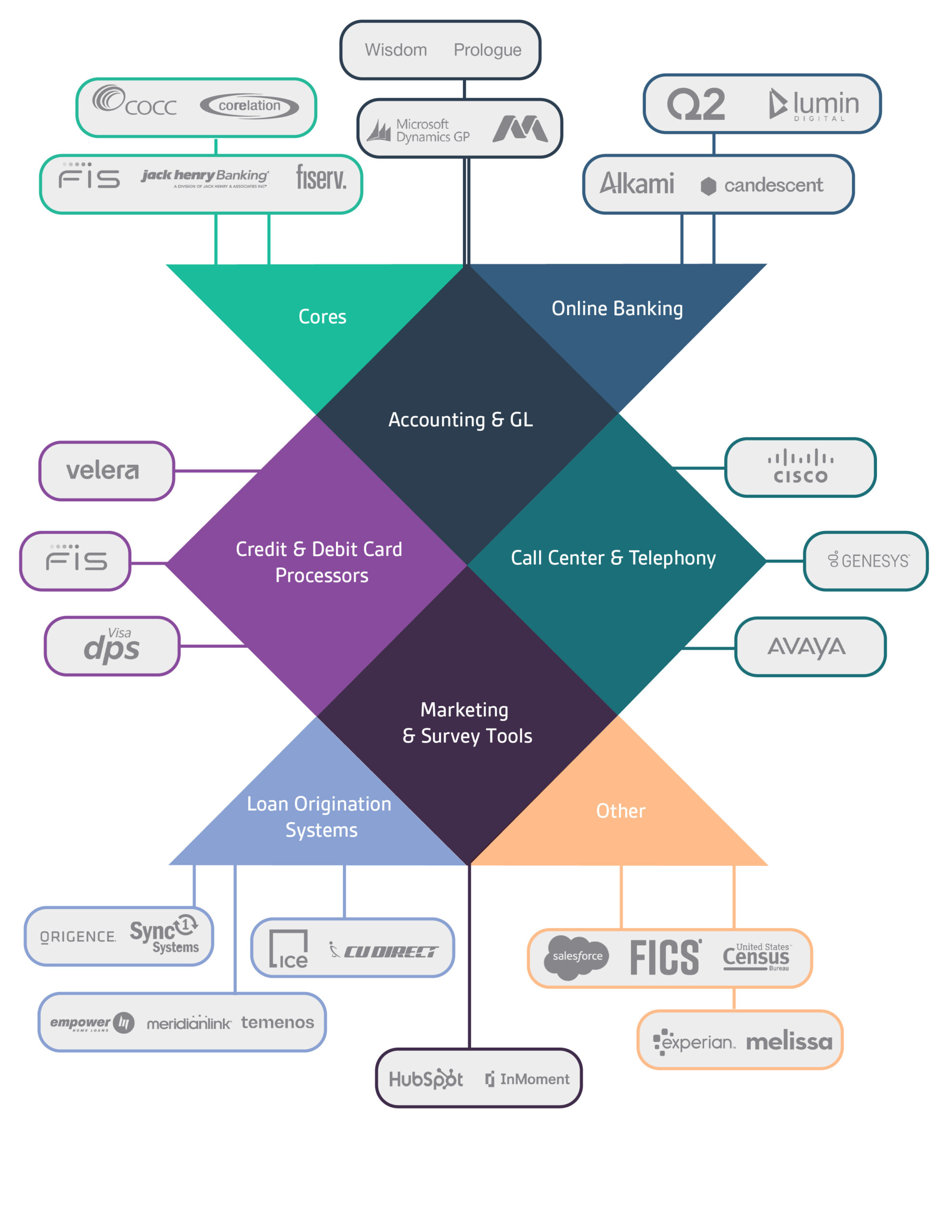
75 integrations and counting

We currently support over 75 integrations – even the ones that other data analytics providers won’t touch. Our integrations incorporate leading credit union and bank solutions, like consumer loan and mortgage originations, digital banking, CRM / MRM, third-party data vendors, and more.

Gemineye integrations infographic

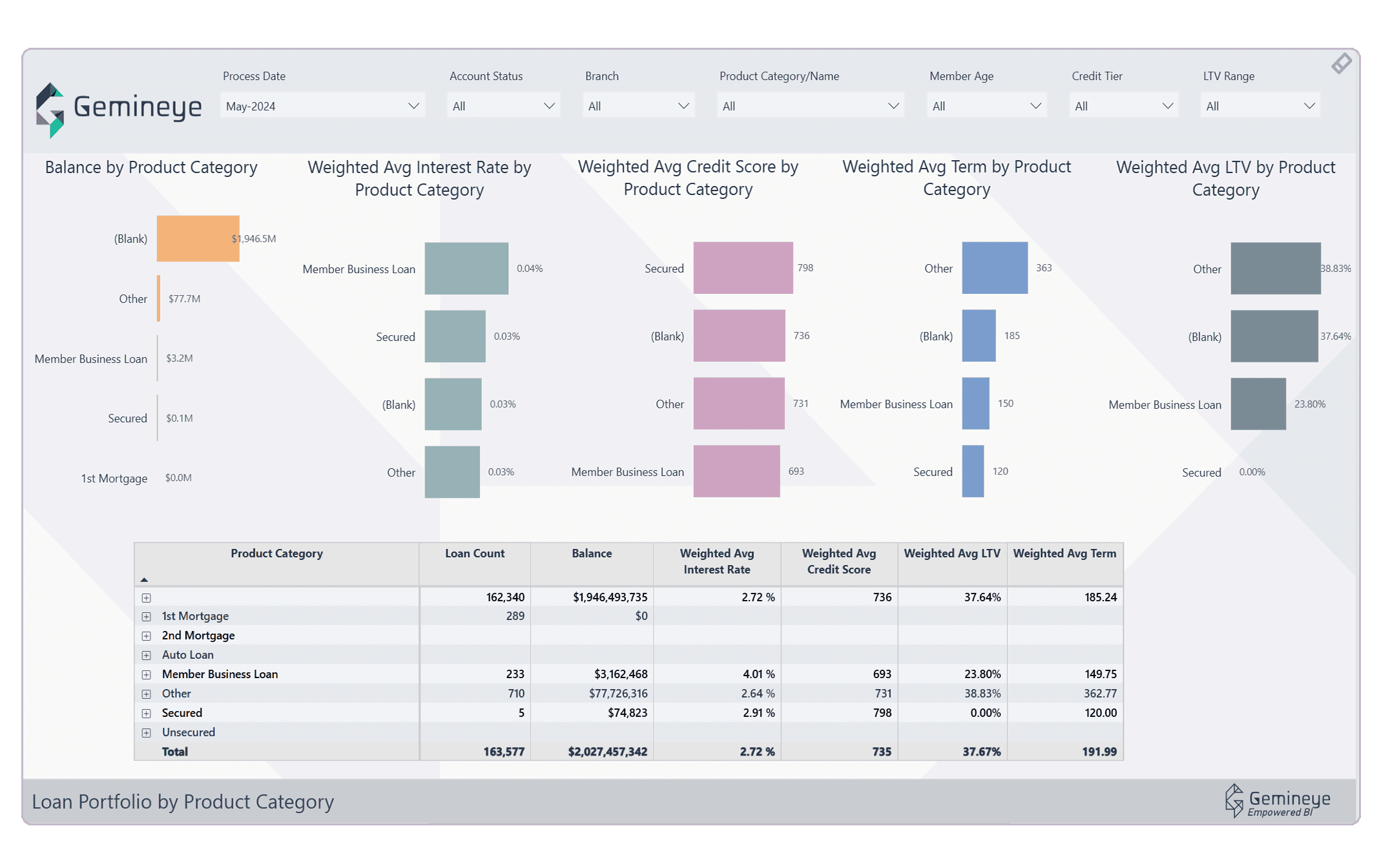
Intertwine financial analysis and operational insights in one solution

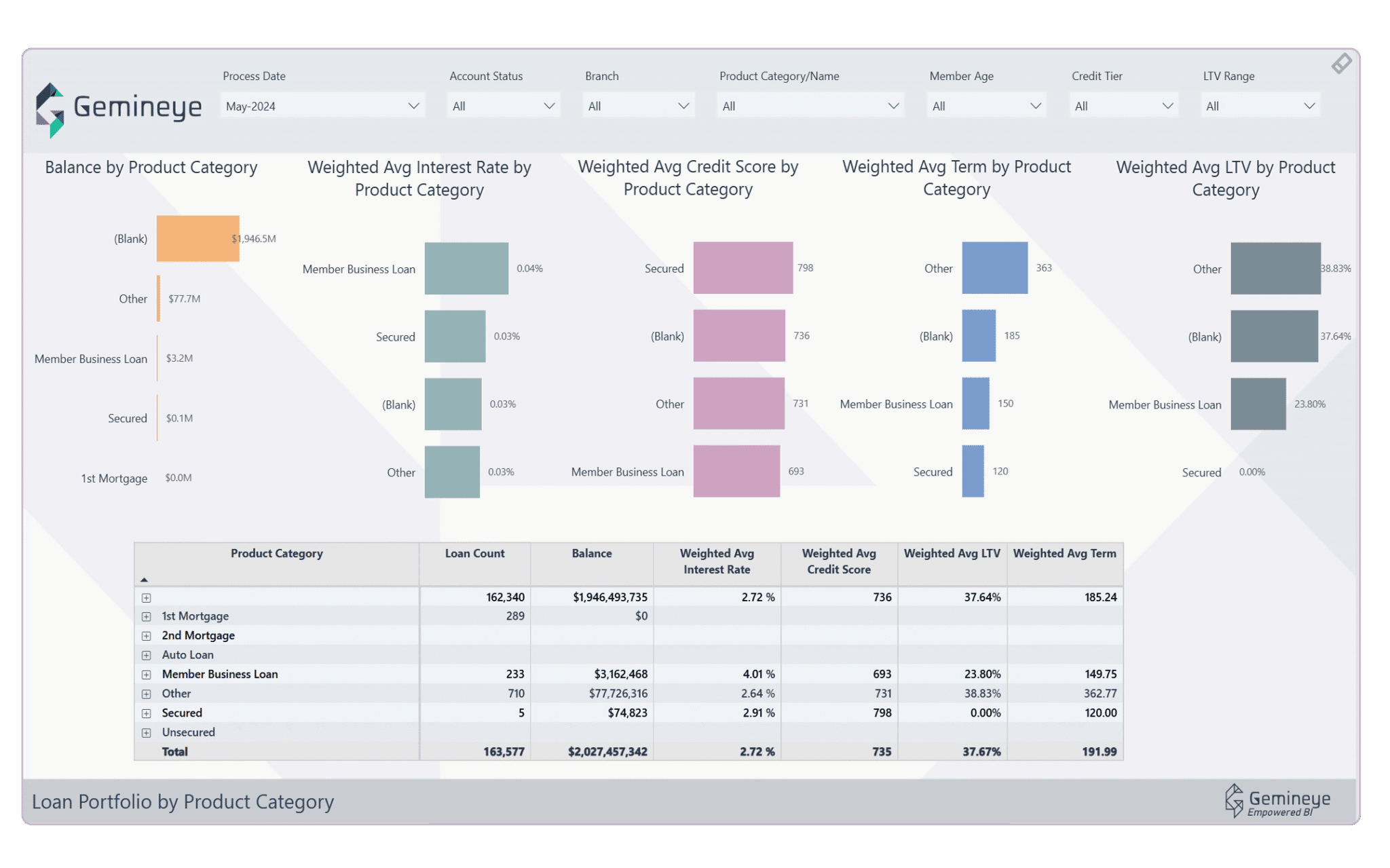
Sick of going to one system to get your current trial balance, another system for your current loan portfolio, and yet another system for deposit analysis? That becomes a thing of the past with Gemineye.
Gemineye data analytics loan portfolio by product category

Intertwine financial analysis and operational insights in one solution

Sick of going to one system to get your current trial balance, another system for your current loan portfolio, and yet another system for deposit analysis? That becomes a thing of the past with Gemineye.
Gemineye data analytics loan portfolio by product category

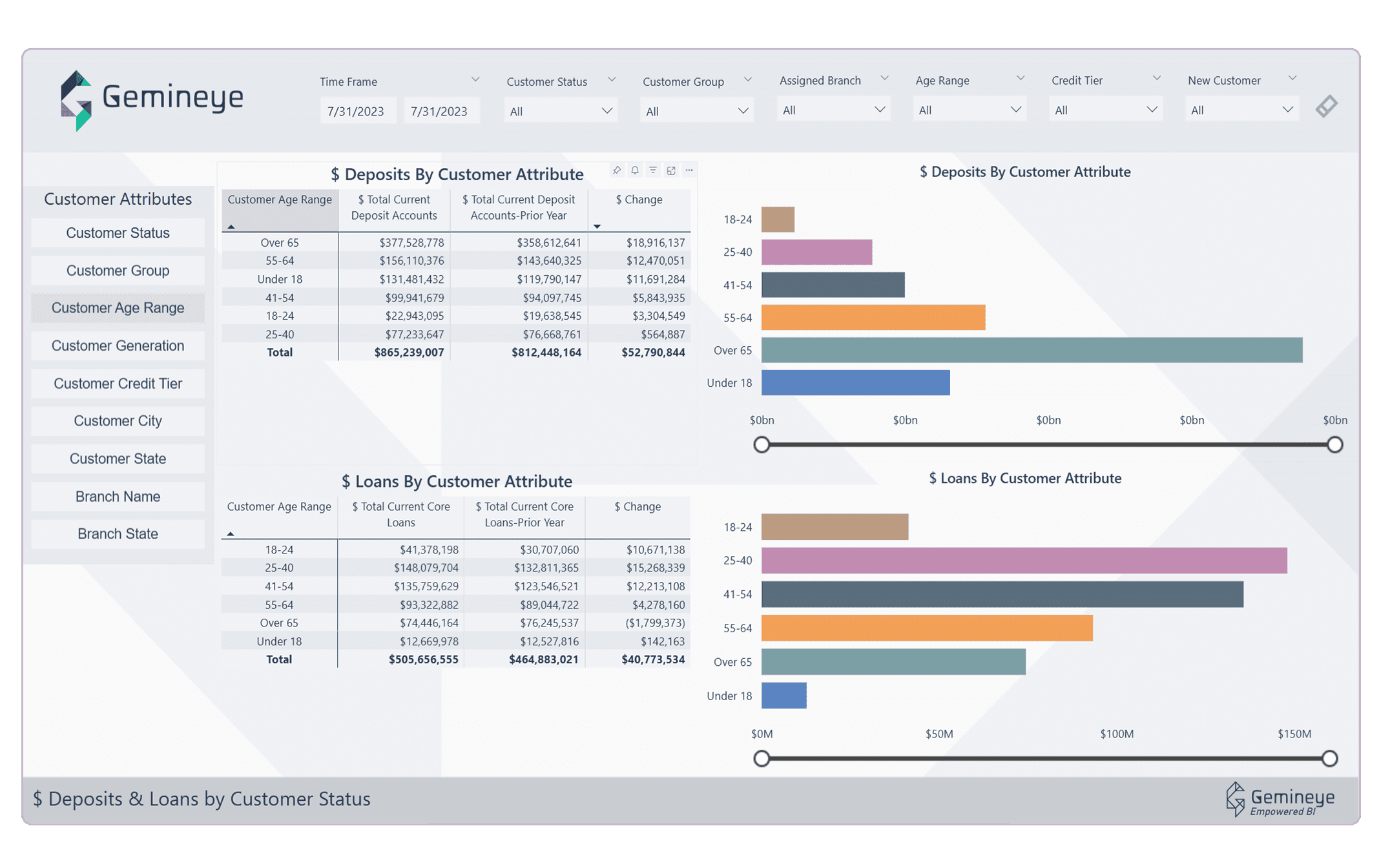
Robust GL reporting

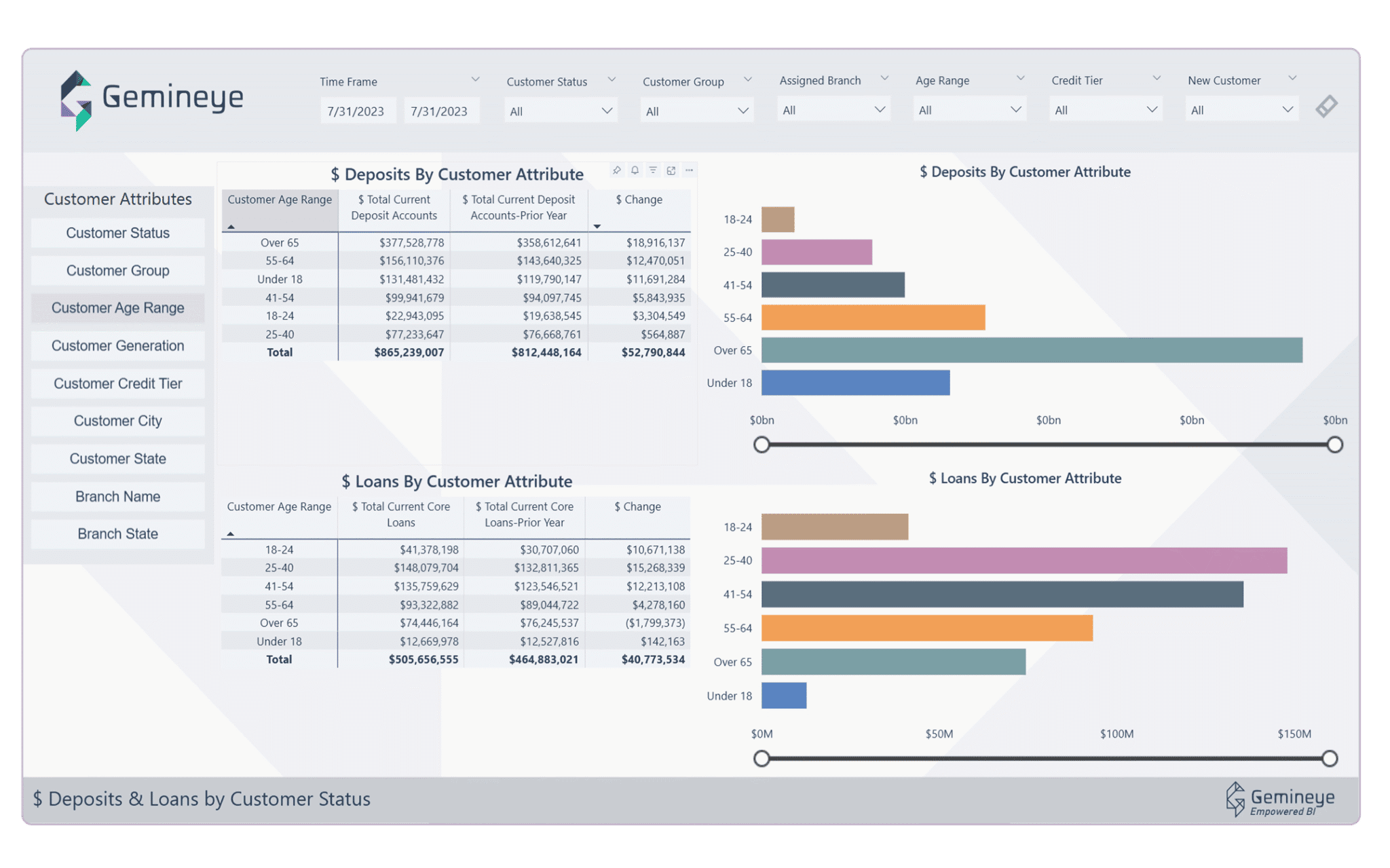
Regardless of your GL system or how complicated your chart of accounts, we seamlessly map these systems into Gemineye to provide advanced financial insights by GL, financial statement and even down to individual regulatory reporting fields.
Gemineye data lakehouse deposits and loans

Robust GL reporting

Regardless of your GL system or how complicated your chart of accounts, we seamlessly map these systems into Gemineye to provide advanced financial insights by GL, financial statement and even down to individual regulatory reporting fields.
Gemineye data lakehouse deposits and loans

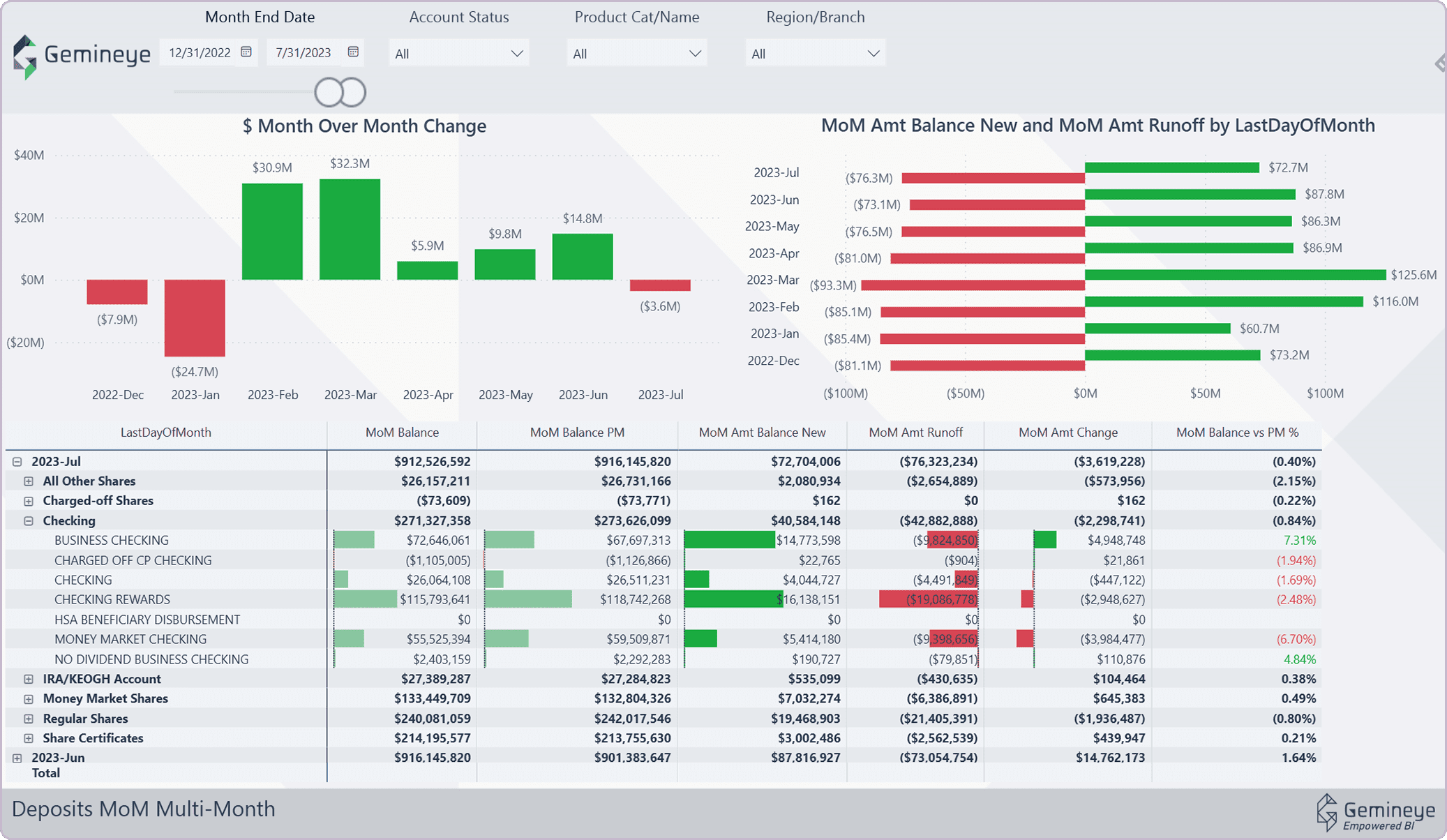
Financial metrics and KPI analysis

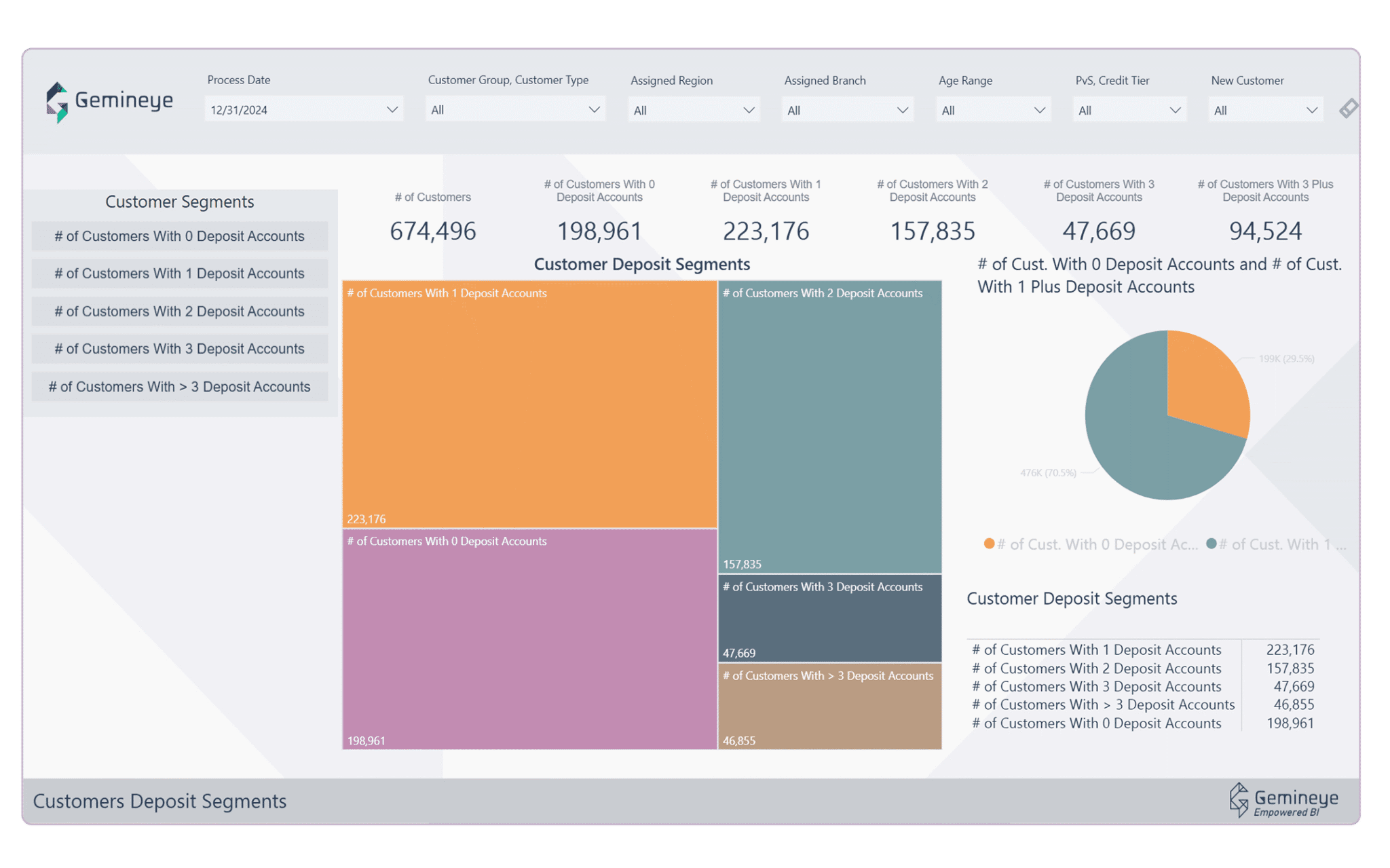
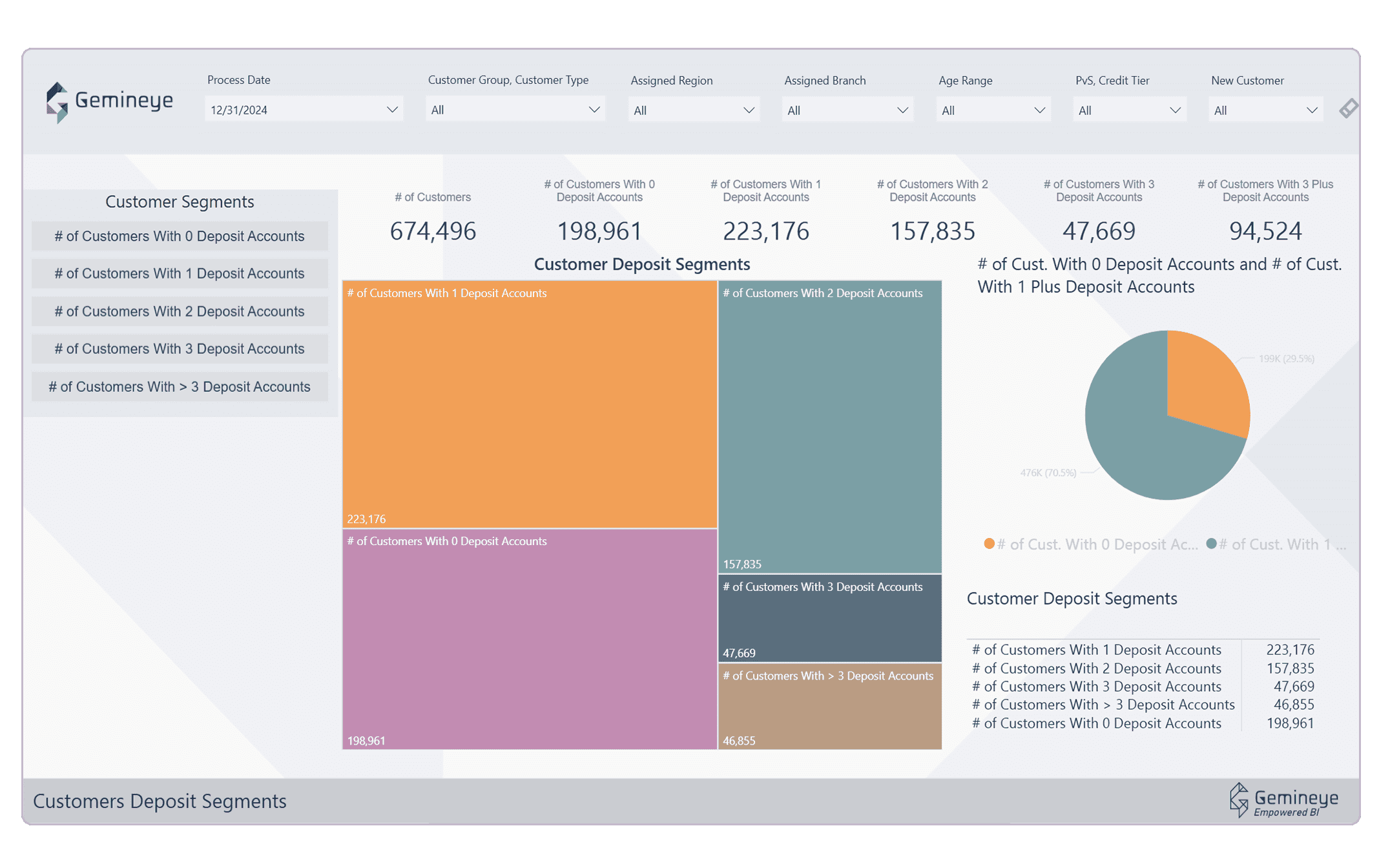
Gone are the days of exporting your data to a spreadsheet just to calculate your KPIs and board metrics. Whether they are high-level or extremely granular, you’ll have full flexibility to leverage calculations and statistical rollups to simplify your financial performance insights.
Gemineye data lakehouse deposit segments

Financial metrics and KPI analysis

Gone are the days of exporting your data to a spreadsheet just to calculate your KPIs and board metrics. Whether they are high-level or extremely granular, you’ll have full flexibility to leverage calculations and statistical rollups to simplify your financial performance insights.
Gemineye data lakehouse deposit segments

Hear from Our Clients

Embracing excellence in data analytics and visualizations, our partnership with Gemineye has been a catalyst for innovation. Their solutions empower us to transform raw data into actionable insights, driving strategic decision-making and fostering a culture of success.
Karl Pagel-Finance
Karl Pagel
Chief Financial Officer
4Front CU
Purple quote icon
Purple quote icon
Showing Slide 1 of 2

Intertwine financial analysis and operational insights in one solution

Sick of going to one system to get your current trial balance, another system for your current loan portfolio, and yet another system for deposit analysis? That becomes a thing of the past with Gemineye.
Gemineye data analytics loan portfolio by product category

Intertwine financial analysis and operational insights in one solution

Sick of going to one system to get your current trial balance, another system for your current loan portfolio, and yet another system for deposit analysis? That becomes a thing of the past with Gemineye.
Gemineye data analytics loan portfolio by product category

Robust GL reporting

Regardless of your GL system or how complicated your chart of accounts, we seamlessly map these systems into Gemineye to provide advanced financial insights by GL, financial statement and even down to individual regulatory reporting fields.
Gemineye data lakehouse deposits and loans

Robust GL reporting

Regardless of your GL system or how complicated your chart of accounts, we seamlessly map these systems into Gemineye to provide advanced financial insights by GL, financial statement and even down to individual regulatory reporting fields.
Gemineye data lakehouse deposits and loans

Financial metrics and KPI analysis

Gone are the days of exporting your data to a spreadsheet just to calculate your KPIs and board metrics. Whether they are high-level or extremely granular, you’ll have full flexibility to leverage calculations and statistical rollups to simplify your financial performance insights.
Gemineye data lakehouse deposit segments

Financial metrics and KPI analysis

Gone are the days of exporting your data to a spreadsheet just to calculate your KPIs and board metrics. Whether they are high-level or extremely granular, you’ll have full flexibility to leverage calculations and statistical rollups to simplify your financial performance insights.
Gemineye data lakehouse deposit segments

75 integrations and counting

We currently support over 75 integrations – even the ones that other data analytics providers won’t touch. Our integrations incorporate leading credit union and bank solutions, like consumer loan and mortgage originations, digital banking, CRM / MRM, third-party data vendors, and more.

Gemineye integrations infographic
Using Data Analytics to Create One Unified Scorecard

Using Data Analytics to Create One Unified Scorecard

Creating a consistent scorecard across departments can be a real challenge for credit unions and community banks. It's rare to see even two departments from the same financial institution utilizing...
READ NOW
Showing Slide 1 of 2

Financial Analytics FAQs

Lorem ipsum dolor sit amet, consectetur adipiscing elit. Lorem ipsum dolor sit amet, consectetur adipiscing elit?

Maecenas nisl sem, lacinia eget justo semper, suscipit tincidunt orci. Maecenas nisl sem, lacinia eget justo semper, suscipit tincidunt orci.

Lorem ipsum dolor sit amet, consectetur adipiscing elit.Lorem ipsum dolor sit amet, consectetur adipiscing elit. Lorem ipsum dolor sit amet, consectetur adipiscing elit.

Test Faq Content

Test Faq Content

Test Faq Content 2

Test Faq ContentTest Faq Content2

How Can Financial Analytics Help Your Team?

Conquer a tough lending environment with tools that reveal opportunities and risks alike

Deliver long-awaited autonomy and flexibility to your finance team with a platform unlike any other

A hard-working data analytics solution for hard working operations teams

Showing Slide 1 of 4
mint green triangle
mint green triangle

News and Resources

Alison Stanback Working

Alison Stanback, Business Intelligence Analyst at Space Coast CU

In this edition of “A Day in the Life of a Data Analyst,” we feature Alison Stanback, Business Intelligence Analyst at $8B Space Coast CU, the third largest credit union in Florida. Alison’s straightforward and optimistic approach to data analytics is equally inspiring and hilarious. She had Alicia Disantis, Head of Marketing at Gemineye, in tears. We sat down to talk with Alison about her grassroots journey into data analytics, her daily routines, and her outlook on communicating with business units. Alison’s Unique Perspective on Data Analytics Alicia Disantis: You started out as a teller at a credit union and have a unique “get it done” perspective on analytics. Tell us what inspired this. Alison Stanback: I started on the front line with members, helping them resolve issues, so that’s how my brain is wired. If there’s a problem, my instinct is always, “Okay, how do we fix it and move forward?” When you come straight from a technology background, it’s easy to focus primarily on the tools themselves. Coming from operations, I tend to start with the problem first and then ask what tools or data we can use to support a better outcome. I’m always thinking there’s more we can leverage if we look at the problem from a different angle. Alicia: Your tolerance is set pretty high. Alison: My tolerance is pretty high. I spent years working in high‑volume branch environments with very real, very human situations happening around me every day. That experience teaches you quickly how to stay calm, de‑escalate, and keep things moving without overreacting. So yes, we have NCUA requirements. Yes, there are a lot of data points and controls we have to account for. But I don’t automatically see that as a crisis. I don’t see chaos, I see opportunity. I think that mindset comes from starting in the branch, not in technology. When you’re used to solving problems face‑to‑face, you learn to focus less on panic and more on progress. Alicia: What got you interested in data analytics, and what do you find most rewarding? Alison: When you’re working with members every day, you naturally start thinking beyond the individual interaction and ask, “How many other members are impacted by this?” I was able to take my branch experience and turn those observations into something actionable. Transforming real member issues into reports and insights that could be shared with the right teams to support better decisions. That’s really how I got hooked on data. Data tells the story of what’s happening. It provides clarity, highlights patterns, and helps connect the dots so leaders can see the full picture and make informed decisions. Being able to show how members are being impacted is what I find most rewarding. I jumped at the opportunity to move from the branches into IT and analytics, and I’ve been there ever since. One thing I truly value about Space Coast CU is their commitment to promoting from within and giving employees opportunities to grow. I’ve been an analyst for nine years, and most of my learning has been hands‑on. I learned alongside an experienced analyst, made plenty of mistakes early on, and gradually picked up best practices. Everything from writing cleaner code to designing dashboards that actually support decision‑making. Leadership was incredibly supportive, and I was never left to figure things out entirely on my own. I don’t have a traditional degree, but I became deeply committed to learning. I spent time watching YouTube content like Guys in the Cube, enrolling in Udemy courses, and continuously building my skills. Space Coast even reimbursed many of those courses, which made a huge difference. Once I started learning, I couldn’t stop! That curiosity is what still drives me today. Alicia: When you became a teller, did you have any idea you were going to spend 20 years in credit unions? Alison: I’ve only had three jobs in my entire life. If I find a place I enjoy, I tend to stay. Space Coast has really become a long‑term home for me. When you spend 40 hours a week working with people, they quickly stop being strangers. You build trust, relationships, and a sense of shared purpose and that’s is what has kept me here. Alicia: You had strong support from your organization and I’ve actually found that to be a common trend in folks I’ve interviewed, that they learn in house rather than obtain formal degrees. I’m curious to know if there were any challenges you faced in your career. Alison: One of the biggest challenges I encountered after moving into data was realizing that not everyone speaks the same “data language.” You can walk someone through an entire presentation, get agreement along the way and then hear, “This is great. Can I have it in Excel?” That experience taught me how important it is to focus on how I communicate insights, not just the insights themselves. My background in customer service helped a lot. When people are dealing with sensitive topics like their finances, they may feel overwhelmed, and if they don’t truly understand what’s being presented, they’re unlikely to act on it. I’ve learned to approach data the same way I approach money conversations: keep it clear, relevant, and accessible. If someone doesn’t understand what they’re seeing, they won’t use the dashboard or take action based on it. Dashboards aren’t just about how they look. They are decision tools. If done well, they replace static spreadsheets by helping people understand why something is happening, not just what happened. A Typical Day for a Business Intelligence Analyst Alicia: Tell me a little bit about your day. What’s the structure of your department and your day-to-day inner workings? Alison: First thing in the morning, I review any incoming tickets to make sure they’re clear and well‑defined. I take time to flesh out the request so what’s documented reflects what the business is actually asking for. Once that’s done, tickets are assigned to the data team and we talk ...

Corelation 2026 Conference Gemineye

Gemineye at the 2026 Corelation Conference

The Gemineye team is so excited to be attending the Corelation Client Conference this year! We’ve been exhibitors at the Corelation Client Conference for a while now, and we’re delighted to have seen their growth and success in the credit union movement through the years. This year, we are making an extra big splash and are very much looking forward to connecting with our clients and meeting new faces in gorgeous San Diego, CA. This year, we’ll be front and center at lucky number booth #77, right by the registration booth, and we’ll also be sponsoring the headshot photo lounge (because you can never have to many headshots, right?) We’d love for you to stop by our booth to share the breakthrough tools we’ve been developing and learn about your data journey in ’26. New Products, Staff, and AI tools The past six months have been big ones for Gemineye, with a new product version launch and several new key team members we’re excited to introduce to you. What might be most exciting, however, is development of our AI assistant – a modern, easy-to-use product different from anything currently available. Interested in seeing our AI assistant in action? We’re hosting a live demo on Friday, May 15th at 11am. Come for the groundbreaking features Stay for the famous cannolis from Nonna’s in Little Italy. 👉 Click here to grab a seat at our demo. Gemineye Sponsors the Headshot Lounge An updated professional headshot is always a good decision. We’re looking forward to sponsoring the Corelation Headshot Lounge (sounds fancy) this year, and will be using it as an opportunity to conduct critical market research around AI, governance, and other data themes. Look for one of our team members to participate and snag a gift card. Book a 1:1 Consultation If you’d like to set up a 1:1 time to talk with the Gemineye team about our business use capabilities or take a technical deep-dive, you can schedule time with us here. Our booth team are experts in data and you’ll be able to talk well beyond the technical depth of the standard booth rep level. 👉 Click here to schedule a 1:1 session with us. Discover More About the Capabilities of the Gemineye Data Lakehouse Interested in learning how the Gemineye Data Lakehouse can provide you with the tools for success? Browse the solutions we provide and teams we help!


Data Lakehouse choices - how to choose for your financial institution

What Isn’t a Data Warehouse? (And Why It Matters) 

Recognizing a Data Warehouse is Critical to Bank and Credit Union Success The number of companies claiming to offer a data solution for financial institutions is increasing at a fast – and alarming – rate. It seems like every week there is a new company  marketing buzzwords like “complete insights,” “member 360 view,” “data-driven,” “comprehensive dashboards,” and everyone’s favorite…“AI-powered analysis.”  Much like the consolidation in the credit union and community bank spaces, technology providers have increasingly converged on similar language to describe very different products. As a result, it’s becoming harder for organizations to distinguish between a true data warehouse solution and tools that simply sit adjacent to it.  But the distinction is critical. Choosing the wrong foundation can lead to:  -Years of wasted time and derailment of your strategic plan  -Six-figures (sometimes more) of sunk cost  -Lack of organizational trust in your data and data program (which can be extremely hard to repair)  In an industry where we are entrusted as fiduciaries of our members’ money, and often operating on a mindful budget, it can be very stressful for business leaders who are trying to make the best decision for their organization’s data needs. In 2026 alone, we’ve counted a half dozen new players who claim to provide a data analytics solution to financial institutions.   In this article, we’ll provide you with the information you need to determine whether an organization is offering a partial analytics service, or a bona fide data analytics solution. This article will focus on what isn’t a data warehouse and highlight what you should know about each look-alike. For each category, we’ll cover:   -What the tool is designed to do   -Why it’s often mistaken for a data warehouse   -What it lacks  -Examples  Continue reading to discover the many data warehouse-adjacent tech solutions available and how to equip yourself with the knowledge you need to make the very best decision for your financial institution.   BI/Analytics-Only Tools What they do: Visualize and analyze data.  Why they’re confused with a warehouse: They’re often the most visible part of the data stack—dashboards are what stakeholders interact with daily.  What they lack:  -Data modeling and transformation  -Centralized governance  -Persistent, reusable business logic  Examples: Looker, Microsoft Power BI, Mode Analytics, Qlik, Tableau  Main Takeaway: Having a viz platform or suite is not indicative of whether the data being used is centralized, modeled, and governed within a warehouse.  Data Analysis & Managed Analytics Providers (“Insights as a Service”) What they do: Provide outsourced analytics, dashboards, and benchmarking.  Why they’re confused with a warehouse: They deliver insights similar to what a warehouse enables—but the underlying data infrastructure isn’t owned or controlled by your organization. Once easy way to identify them is: if you send them your data and they return reports, dashboards, or recommendations, they likely fall in this category.  What they lack:  -Visibility and direct access to modeled data  -Flexibility to answer new questions quickly  -Ownership of transformation logic  Examples: Empyrean Solutions, nCino, Nomis Solutions, ProfitStars, Callahan  Main Takeaway: If you have to package and send your data, this is an analysis service, not an owned and governed warehouse.  Reverse ETL Tools What they do: Push data from a warehouse into operational systems (e.g., CRM, marketing tools).  Why they’re confused with a warehouse: They interact with many business systems and are often positioned as part of the “modern data stack.”  What they lack:   -Data storage   -Transformation logic  -Governance  Examples: Census, Hightouch, Polytomic, RudderStack, Segmint, MelissaData  Main Takeaway: Reverse ETL tools are often apart of a robust outcome drive data initiative, but their function doesn’t replace the necessary lifting that happens before data is returned to ancillary tools.  Customer Data Platforms (CDPs) What they do: Build unified member/customer profiles for marketing and engagement.  Why they’re confused with a warehouse: They promise a “single customer view,” which sounds similar to a 360-degree data model.  What they lack:  -Full business data coverage (finance, operations, risk, etc.)  -Flexible analytics across domains  -Cross-functional metric standardization  Examples: Alkami, mParticle,Salesforce Data Cloud, Segment (Twilio), Tealium   Main Takeaway: A CDP only knows your member/customer, not your entire business.  Data Augmentation Platforms What they do: Clean, enrich, or enhance existing datasets.  Why they’re confused with a warehouse: They improve data quality, which is often associated with “better data infrastructure.”  What they lack:   -Centralized data modeling  -Historical tracking and lineage  -Enterprise-wide metric consistency  Examples: Experian data enrichment, Lob (address standardization), Census data  Main Takeaway: Better data ≠ governed data.  Core Banking/Operational Systems What they do: Process transactions and run day-to-day business operations.  Why they’re confused with a warehouse: They are often treated the single source of truth in lieu of having standardization across data sources.  What they lack:  -Analytical performance at scale  -Historical modeling and transformations  -Cross-system integration  Examples: Corelation (KeyStone), Jack Henry, Finastra, Fiserv, FIS  Main Takeaway: Your core system is a key source of collecting data, but isn’t optimized to hold everything, maintain historicals, or analyze it.  Marketing Platforms/MCIF What they do: Enable campaigns, segmentation, and member engagement.  Why they’re confused with a warehouse: They often present unified customer experiences and segmentation.  What they lack:   -Governed enterprise-wide data models  -Consistent metric definitions  -Deep analytical flexibility  Examples: Adobe Experience Platform, HubSpot, Salesforce Marketing Cloud, Strum  Main Takeaway: A unified experience is not a unified data model.  AI/Advanced Analytics Platforms What they do: Build models, predictions, and advanced analytics.  Why they’re confused with a warehouse: They are often marketed as “intelligent data platforms.”  What they lack:   -Standardized business definitions  -Governed metrics  -Foundational data modeling  Examples: AWS SageMaker, Azure Machine Learning, Dataiku, DataRobot, SAS  Main Takeaway: Like Reverse ETL Tools, AI and ML platforms work on already modeled and governed data, not before.   Why Choosing a True Data Warehouse Matters When financial institutions confuse data warehouse adjacent tools with a true data warehouse, several problems emerge:  -Inconsistent metrics: Different teams define KPIs differently (i.e. what is a member?)  -Lack of trust: Reports don’t match across departments and erodes morale.  -Wasted effort: Analysts repeatedly rebuild the same logic, sometimes week over week.  -Wasted money: The upfront sunk costs of the vendor selection process, training, onboarding and implementation, and the ongoing cost of paying a vendor who isn’t providing the services you need adds up fast.  -Lost time: In the race to connect with members and predict their needs, lost time puts organizations behind the 8 ball against their competitors.   -Slower decision-making: Teams across the organization debate numbers instead of acting on them.  Quick Reference Guide Tool Category  Primary Use  Why It’s Not a Warehouse  BI Tools  Visualization  No data modeling or governance  Managed Analytics  Outsourced insights  No internal ownership of data  Data Lakes  Storage  No standardized metrics  Reverse ETL  Activation  Depends on warehouse  CDPs  Customer profiles  Limited scope  Data Augmentation  Data quality  No modeling or governance  Core Systems  Transactions  Not optimized for analytics  Marketing Platforms  Engagement  No unified data model  AI Platforms  Predictions  No metric definition  What a Data Lakehouse Actually Is A data warehouse is a structured, modeled system designed specifically for analytics and reporting.  It provides:   -Governed, consistent metrics   -Standardized business definitions   -Historical tracking and transformations   ...

Showing Slide 1 of 4

Ready to finally have control over your data analytics experience?

We offer complimentary consultations – never pushy, always honest.