
If you know credit unions, you know how often they prioritize community impact, and analytics provider Gemineye is thrilled to be a part of these efforts by partnering with their client $1.6B, Michigan-based Financial Plus Credit Union (FPCU) to deliver an incredible experience for the next generation of technology professionals.
As part of FPCU’s strategic partnership with Kettering University, Kettering Co-op students have the opportunity to gain hands-on, real-world experience while working alongside FPCU’s team. Unlike a traditional internship, Kettering’s Co-op program is an immersive part of the students’ education, combining alternating academic and full-time paid Co-op terms throughout their entire time at the university.
FPCU’s Co-op students work alongside professionals, gaining meaningful experience in their fields while contributing to projects that have a real impact on the organization. In the Spring 2026 semester, FPCU and Gemineye collaborated to take that experience to the next level.
The outcome? A series of unexpected benefits stretching far beyond community involvement:
- Understanding how business users interpret data
- The importance of requirement gathering before a data project
- A renewed focus on context and simplicity
- Overall better communication between the technical and non-technical teams at FPCU
Maggie Chopp, Director of Business Development at Gemineye said, “Credit Unions are often incredible doors to opportunity for young professionals to grow in a hands-on environment – I know from my own experience starting out in credit unions. FPCU’s ongoing commitment to bringing the best educational opportunities possible to the Kettering University Co-Op students is great example of the educational impact CUs can make. And by partnering with Gemineye, they were able to further develop these valuable STEM experiences.”
“We believe education is one of the most meaningful ways we can invest in the future of our communities,” said Ciara Vendittelli, Community Impact Manager at FPCU. “Through our partnership with Kettering, we have the opportunity to give students meaningful experiences, connections and opportunities to apply what they’re learning in the classroom. Helping students build the skills and confidence to pursue the careers they’re passionate about is an investment in our community and our future.”
Working together, FPCU was able to enrich the education for local students while improving their reporting infrastructure at the same time. Turns out, you can learn a lot from giving back.
Developing the Next Generation Through Real-World Experience
FPCU is a powerhouse community leader throughout Michigan. In 2026, they were named one of America’s Best Regional Credit Unions due to their operational performance, health and stability, and delivering outstanding experiences for members and the community. It’s no surprise that they have a flourishing multi-year partnership with Kettering University in Flint, MI, aimed at enhancing financial education and resources for students. As part of the partnership, FPCU welcomed Kettering Co-op students Blair Zagata and Stanford Ngo to its IT team, where they are gaining hands-on experience and contributing to meaningful projects while earning their degrees. In addition to their daily tasks and general learning, Stanford and Blair were tasked with an intensive project that they could “really sink their teeth into,” by Tony Patten, Director of IT Infrastructure at FPCU.
 “We wanted to give Blair and Stanford more than daily tasks to check off a list. We wanted to challenge them with something meaningful that they could take ownership of, learn from, and ultimately add to their professional portfolios. An invaluable part of their experience is having access to a network that extends beyond our own team, connecting them with IT professionals, industry experts and leaders in the field. Those opportunities help them expand their network, sharpen their skills and grow into better leaders in the fields they’re passionate about.”
Director of IT Infrastructure at FPCU
The project consisted of updating the credit union’s IT workload dashboard, a low-hanging-fruit in need of high-level visibility for the interns to focus on. Students developed an initial framework with the data available and joined coaching sessions with Gemineye’s Sabrina Jordan to get their reports production ready. Sessions included best practices with requirement gathering, visualization standards, and top-tier design principles. Students got to observe the design and UAT process, witnessing the real-life development cycle in action.
How Financial Institutions Struggle with Data Visualization
What started as a small project for Co-Ops evolved into a robust exercise in best-in-class data visualization that many community financial institutions could learn from. Gemineye has seen a pattern in common data visualization issues for lean teams who don’t have a dedicated expert in this niche. The dashboards often suffer from:
- Lack of a clear story
- Irrelevant metrics
- Too many visuals on a page
- Unpredictable color patterns
- Lack of context
- Interpretation difficulties
- Vague data sets
All of these issues add up to increase cognitive load on the report recipient, making it harder to turn information into action.
 “The most important thing to know before any report is the intended audience, because everything else is determined by this: what to include, what to exclude, the level of detail to show, the way the story is framed, and what they need in order to do their jobs. The biggest mistake I see is starting with requirements for a giant table and needing to export it to Excel. If your data needs more manipulation before you can draw insights from it, your reports aren’t doing their job. What questions are you trying to answer for the target audience? Start with the audience, then the questions; don’t start with the data you want to include.”
Architect Consultant at Gemineye
The Importance of Context in Data
Sabrina worked directly with the credit union stakeholders and Co-Ops to define the success criteria of the report. The stakeholders identified that there was a lack of clear workload visibility and resolution metrics, which resulted in limited ability to assess capacity, manage demand, and ensure timely delivery.
Essential questions that needed clarity included:
- What does the incoming IT work consist of? (volume, type, and effort)
- What months is the team getting ahead? What things were happening at the time to contribute to that success?
- How long on average are tickets taking to complete? What types of tickets absorb the most resource time?
- How is workload distributed across team members? Is the reactive workflow and lack of workload clarity driving team burnout?
- To meet the demands of the credit union, is the team capacity sufficient, or what would need to change to ensure demands are met?
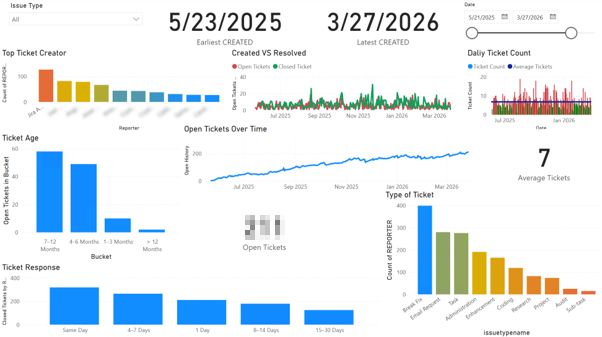
The Report Before
The Report After
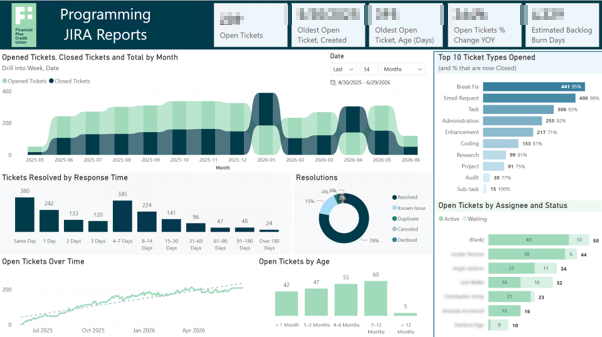
As a part of the report remodel, the most important metrics were moved to the top, followed by trends over time and categorical breakdowns.
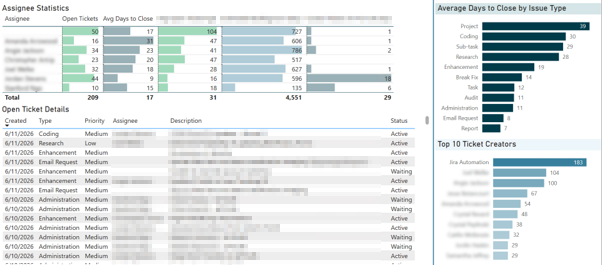
Due to Power BI’s interactivity, report users can click on any timeframe or category, and the detail table at the bottom will automatically filter to show relevant tickets, giving rapid insight into the composition of work.
Consistent FPCU color branding was added, visuals were sorted to be more user friendly, and above all, each visual was designed to answer a question that IT leadership was asking.
Requirement Gathering, an Underutilized Step in Data Projects
Gemineye’s Maggie Chopp, a former credit union analyst herself, can’t stress enough the importance of requirement gathering for a success analytics project. “Data projects often get started on the wrong foot when analysts are given datasets without sufficient understanding of the business problem, or personal experience with the questions the business teams are asking.”
Sufficient requirement gathering prevents this common pitfall by allowing the development team to really get to the heart of what their end users want to see. The end solution is often pre-determined by the success of this stage, which is what makes it so critical. Gemineye’s Sabrina coached the Co-Ops on how to conduct a successful requirement gathering process, helping them learn foundational soft-skills as well as technical prowess.
The Project’s Impact on Students
For Stanford and Blair, the Kettering Co-Op experience has provided an opportunity to take what they are learning in the classroom and apply it to real-world IT projects while working alongside FPCU professionals and industry experts. Their experiences have allowed them to develop technical skills, build professional confidence and gain a deeper understanding of what it means to work in the IT field.
Stanford Ngo, Kettering Co-Op student, shared, “My experience as a Kettering Co-op has been a great opportunity to apply what I’ve learned as a student in a real-world IT environment. Working with FPCU has helped me gain technical, professional knowledge, and soft skills, which has all granted me a better understanding of how IT operates in a professional setting. I truly appreciate the opportunity FPCU has given me to learn, grow my skillset, and build experience that I can carry forward into my future career.”
For Blair Zagata, the experience has also provided an opportunity to explore areas of technology that align with his interests and build skills he can carry into his career.
“I have always been a hands-on learner, and I am very grateful for the opportunities I have been given at FPCU. Power BI and data visualization have always been areas of interest to me, but I never had access to data that required the use of these tools. Being able to work with Power BI and learn from industry professionals has been a great experience. I have developed many valuable skills, including SQL, DAX, and building star schemas. These are skills that will continue to benefit me as I grow in my career.”
Conclusion
While the Co-op experience was designed to challenge Blair and Stanford and help them grow, the benefits extended to FPCU as a whole. The updated dashboard gave the IT team a more effective tool for understanding and managing its workload.
 “Great dashboards don't answer every question. They answer the right questions. Because Gemineye took the time to clearly define our goals and the decisions we needed to support, we were able to transform raw ticket data into meaningful insights. The dashboard gives us a clear view of team capacity, workload, and demand, creating alignment across the organization and helping us make better decisions about where to focus next.”
Director of Innovation & Product Management at FPCU
As a credit union and community bank-specific analytics provider, Gemineye enthusiastically supports the credit union mission of people helping people. This partnership with FPCU and the Kettering University students was a natural fit for both teams to shine.
“Credit union leaders often have similar origin stories as students, interns or entry level positions – so I think it’s easy for our audience to appreciate the emphasis we put on education” explains Gemineye’s Maggie Chopp. “We honored to be a part of the “people helping people” philosophy.”
If you are interested in learning how Gemineye can help your community bank or credit union with best-in-class analytics consulting, contact us today.
About Gemineye
At Gemineye, we believe that a practical and usable data program is the key to success. We believe that community-based Fis deserve access to the same world-class technology that Fortune 50 companies use. And whether you are part of a $300M credit union or a $25B bank, you should have the ability to implement a data solution that works the way you need it to. That’s why we take a different approach to data analytics, one that puts you back in the driver’s seat of your own data journey, delivered by best-in-class technology. We’re Gemineye – allowing you to drive the data and the journey.
Email us at sales@gemineye.com or call (508) 591-3303. Visit us at gemineye.com to learn more at your own pace.
Discover More About the Capabilities of the Gemineye Data Lakehouse
Interested in learning how Gemineye can support your team like FPCU? Browse the solutions we provide and teams we help!